Pearson Edexcel · GCSE · English Language
Course version: 1EN0 · Version from Mar 2026
Non-fiction and Transactional Writing - 2.1 Reading: 2.1.1 read and…
Full specification wording
Component 2: Non-fiction and Transactional Writing - 2.1 Reading: 2.1.1 read and understand a range of non-fiction texts, including whole texts and unseen texts
This skill means reading non-fiction actively and accurately, not just decoding words.
Checked against the Pearson Edexcel 1EN0 specification (opens in a new tab) on .
- Point 1 of 5
- 4 key terms
Study notes
From the checked teaching notes for this specification point.
The idea
This skill means reading non-fiction actively and accurately, not just decoding words. You must cope with whole texts, where ideas build across paragraphs, and unseen texts, met for the first time under timed conditions. Start by skimming for the gist: what is the writer's subject, purpose and audience? Then scan for key details, dates, names and figures. Track how each paragraph develops the argument or account, and note where the writer shifts tone or viewpoint. For example, in a travel article about a flooded town, the opening may describe damage, the middle quote residents, and the close appeal for donations. Understanding means you can say what the text is about, what happens or is claimed, and how the parts connect, using your own words where possible.
Common mistakes and how to put them right
Retelling the text in order instead of selecting what answers the question.
Put it right: Read the question first, then hunt for the two or three most relevant details.
Copying whole sentences as evidence without explaining them.
Put it right: Quote briefly, then state in your own words what the quotation shows.
Assuming an unseen text will be too hard and reading it passively.
Put it right: Skim for gist, then scan for the specific information the question demands.
Exam tips
- Read the question before the text so you know what information to look for as you read.
- Annotate the text lightly: underline key names, figures and topic sentences, and label paragraphs with one or two words.
- Answer in your own words wherever you can, keeping quotations short and tightly linked to your point.
Try the lesson
The start of the Component 2: Non-fiction and Transactional Writing - 2.1 Reading: 2.1.1 read and understand a range of non-fiction texts, including whole texts and unseen texts lesson, made from checked teaching notes for this specification point.
Have a go first
Read this sentence from a non-fiction article: 'The council closed the park for six weeks while new paths were laid.' What reason does the article give for the park being closed?
Listen
This skill means reading non-fiction actively and accurately, not just decoding words. You must cope with whole texts, where ideas build across paragraphs, and unseen texts, met for the first time under timed conditions. Start by skimming for the gist: what is the writer's subject, purpose and audience? Then scan for key details, dates, names and figures. Track how each paragraph develops the argument or account, and note where the writer shifts tone or viewpoint. For example, in a travel article about a flooded town, the opening may describe damage, the middle quote residents, and the close appeal for donations. Understanding means you can say what the text is about, what happens or is claimed, and how the parts connect, using your own words where possible. A common slip: Retelling the text in order instead of selecting what answers the question. Instead, read the question first, then hunt for the two or three most relevant details. Exam tip: Read the question before the text so you know what information to look for as you read.
See it
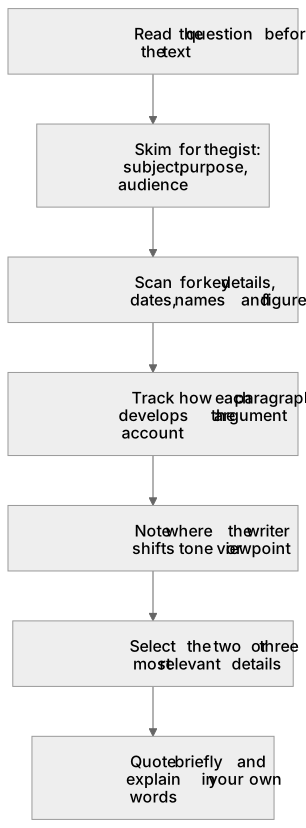
Put it in order
Put these steps in the order they happen.
- 1. Quote briefly and explain in your own words
- 2. Select the two or three most relevant details
- 3. Scan for key details, dates, names and figures
- 4. Note where the writer shifts tone or viewpoint
- 5. Read the question before the text
- 6. Skim for the gist: subject, purpose, audience
- 7. Track how each paragraph develops the argument or account
Key words
Say what each word means before you turn the card.
Comprehension of whole texts
Try answering aloud or in your head before turning the card.
Unseen non-fiction reading
Try answering aloud or in your head before turning the card.
Selecting relevant detail
Try answering aloud or in your head before turning the card.
Reading for purpose and audience
Try answering aloud or in your head before turning the card.
See every definition
- Comprehension of whole texts
- Reading actively and accurately so you can say what the text is about, what happens or is claimed, and how the parts connect.
- Unseen non-fiction reading
- Coping with texts met for the first time under timed conditions, skimming for the gist and scanning for key details.
- Selecting relevant detail
- Hunting for the two or three most relevant details after reading the question first, rather than retelling the text in order.
- Reading for purpose and audience
- Skimming for the gist to establish the writer's subject, purpose and audience before scanning for key details, dates, names and figures.
Label the diagram
Some boxes have lost their names. Pick the right name for each number.
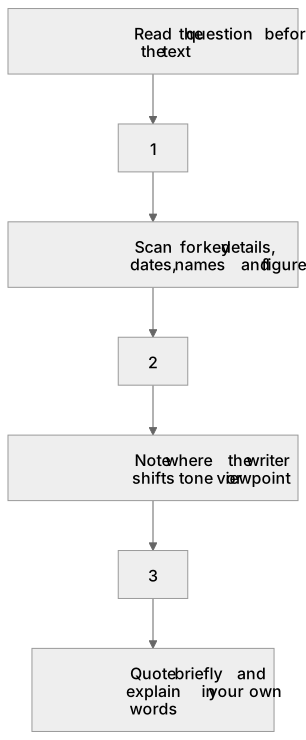
1Box 1
2Box 2
3Box 3
There is more to this lesson
The full lesson goes on to check your understanding and help you earn the marks. Create a free account to carry on, with your progress saved.
A week of Premium from your first lesson · Then the free plan continues · No card, no charge
Test your understanding of Component 2: Non-fiction and Transactional Writing - 2.1 Reading: 2.1.1 read and understand a range of non-fiction texts, including whole texts and unseen texts
Active recall beats re-reading. Take an instant quiz now to test what you’ve learned and lock it into long-term memory.
A week of Premium from your first lesson · Then the free plan continues · No card, no charge